
Poland Used Bus Registrations 2026: Brands, Age & Market
Poland as an outlet market for used buses
Poland takes in thousands of used buses every year, and the registration data for January-September 2026 show what that market looks like in practice: which brands arrive, how old the vehicles are, and how a sharp rise in new-bus registrations is changing the picture. This study draws on the Central Vehicle Register (CEP) as compiled by PZPM and JMK, covering first registrations in Poland of both new and used buses.
The used-bus flow: 2,553 vehicles, led by Western European brands
Used buses registered in Poland for the first time reached 2,553 in January–September 2026, compared with 2,668 in the same period of 2025, a change of -4.3%. These are vehicles already registered in another country that enter the Polish register for the first time. The file does not say which country they come from.
Iveco leads the used segment with 777 registrations, representing 30.4% of all used buses registered. Mercedes-Benz follows with 732 registrations (28.7%). Setra accounts for 228 (8.9%) and MAN for 136 (5.3%). Van Hool, with 66 registrations (2.6%), posted the strongest year-on-year growth among the named brands at +22.2%. SOR, by contrast, recorded a sharp decline of -49.4%, falling to 78 registrations (3.1%).
Exhibit 1 — Used buses registered in Poland for the first time, by brand, January–September 2026
Brand | January–September 2026 | Share | January–September 2025 | Change |
|---|---|---|---|---|
Iveco | 777 | 30.4% | 781 | -0.5% |
Mercedes-Benz | 732 | 28.7% | 723 | +1.2% |
Setra | 228 | 8.9% | 255 | -10.6% |
MAN | 136 | 5.3% | 148 | -8.1% |
SOR | 78 | 3.1% | 154 | -49.4% |
Van Hool | 66 | 2.6% | 54 | +22.2% |
Other brands | 536 | 21.0% | 553 | -3.1% |
Total | 2,553 | 100.0% | 2,668 | -4.3% |
_Source: PZPM and JMK, analysis of the Central Vehicle Register (CEP), file PZPM_JMK_CEP_AUTOBUSY_09_2026.xlsx. Shares and changes calculated by Fleequid from the counts._
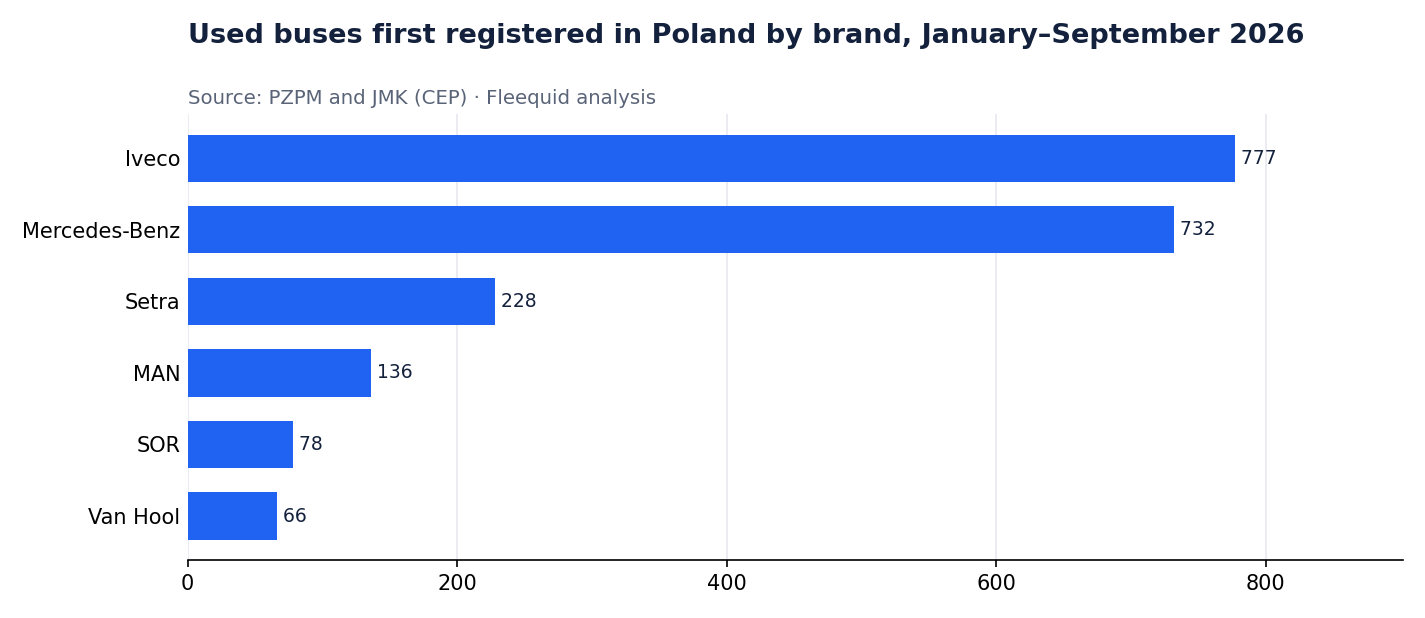
The top of the ranking is concentrated: Iveco and Mercedes-Benz together account for 59.1% of used registrations (1,509 of 2,553). They are among the most common brands in European bus and coach fleets, which is the most plausible reading of this ranking; the PZPM data, however, do not record where the vehicles come from.
For dealers and operators sourcing used stock, the brand ranking shows what the Polish market absorbs. Iveco and Mercedes-Benz held steady year on year (-0.5% and +1.2%), so demand for these two brands is stable. Setra (-10.6%) and MAN (-8.1%) lost ground, and SOR almost halved (-49.4%).
Age profile: a fleet drawing on vehicles from an extended production window
The age structure of used imports is as informative as the brand breakdown. The most frequently registered year of manufacture is 2016, with 244 vehicles (9.6% of the used total). The second most common is 2009, with 232 registrations (9.1%), followed by 2015 with 211 (8.3%), 2014 with 205 (8.0%), and 2013 with 197 (7.7%).
Exhibit 2 — Used buses registered in Poland for the first time, by year of manufacture, January–September 2026
Year of manufacture | Buses | Share |
|---|---|---|
2026 | 49 | 1.9% |
2020 | 68 | 2.7% |
2019 | 103 | 4.0% |
2018 | 108 | 4.2% |
2017 | 149 | 5.8% |
2016 | 244 | 9.6% |
2015 | 211 | 8.3% |
2014 | 205 | 8.0% |
2013 | 197 | 7.7% |
2012 | 157 | 6.1% |
2011 | 189 | 7.4% |
2010 | 175 | 6.9% |
2009 | 232 | 9.1% |
2008 | 184 | 7.2% |
2007 | 77 | 3.0% |
Other years | 205 | 8.0% |
Total | 2,553 | 100.0% |
_Source: PZPM and JMK, analysis of the Central Vehicle Register (CEP), file PZPM_JMK_CEP_AUTOBUSY_09_2026.xlsx. Shares and changes calculated by Fleequid from the counts._
At least 1,871 of the 2,553 used buses, representing at least 73.3%, were built in 2016 or earlier. The other 205 vehicles (8.0%) are grouped by PZPM under «other years», the years not listed individually: they could be more recent, such as 2021 to 2025, or older than 2007, so the share built in 2016 or earlier may be higher still. Within a single nine-month period, the registrations span almost twenty years of production.
This has direct implications for operators. Vehicles entering Polish service range from relatively recent examples to units that have served two or more fleet cycles abroad. The coexistence of different generations in the same registration cohort reflects the diversity of Polish operators: municipal authorities, regional carriers, school transport providers, and private coach companies all participate in the used market, each with different age tolerance and budget constraints.
For sellers, the age data suggest that Polish buyers do not apply a single age threshold. Vehicles from very different production years find a buyer here, which, if the pattern holds in the coming months, widens the range of fleet disposals that can be offered on this market.
Segments: intercity and coach drive used demand, city buses go new
The segment breakdown clarifies where used and new buses serve structurally different roles in the Polish market.
Exhibit 3 — First registrations in Poland by segment, new and used buses, January–September 2026
Segment | New 2026 | New 2025 | Used 2026 | Used 2025 |
|---|---|---|---|---|
Minibus (under 8 t) | 1,024 | 968 | 647 | 664 |
City bus | 1,537 | 334 | 264 | 247 |
Intercity bus | 234 | 151 | 899 | 968 |
School bus | 1 | 3 | 2 | 5 |
Coach | 308 | 386 | 650 | 684 |
Other | 3 | 1 | 91 | 100 |
Total | 3,107 | 1,843 | 2,553 | 2,668 |
_Source: PZPM and JMK, analysis of the Central Vehicle Register (CEP), file PZPM_JMK_CEP_AUTOBUSY_09_2026.xlsx. Shares and changes calculated by Fleequid from the counts. Minibus: gross vehicle weight under 8 tonnes; the other segments are 8 tonnes and over._
In the intercity segment, used registrations reached 899 against 234 new, making used vehicles the dominant source of supply. The coach segment shows a similar pattern: 650 used against 308 new. These two segments together account for the largest share of used registrations, and both are populated primarily by Iveco, Mercedes-Benz, Setra, and MAN vehicles from Western European long-distance and regional fleets.
The city bus segment tells a different story: 1,537 new registrations against only 264 used, up from 334 new in the same period of 2025. A likely explanation is public procurement co-financed with EU funds, which usually calls for new vehicles, often low- or zero-emission ones; the PZPM file does not give the reason. Used city buses enter the market in small numbers compared with these new deliveries.
The minibus segment (under 8 tonnes) is relatively balanced, with 1,024 new and 647 used registrations. Coaches and intercity buses are where the used market remains structurally significant, and those are precisely the segments dominated by Western European brands.
New registrations: a surge driven by city buses and Solaris
New bus registrations in Poland reached 3,107 in January–September 2026, a change of +68.6% compared with 1,843 in the same period of 2025. This is the most consequential single figure in the dataset for assessing the future of used imports.
Exhibit 4 — New buses registered in Poland, by brand, January–September 2026
Brand | January–September 2026 | Share | January–September 2025 | Change |
|---|---|---|---|---|
Mercedes-Benz | 910 | 29.3% | 768 | +18.5% |
Solaris | 820 | 26.4% | 142 | +477.5% |
Iveco | 254 | 8.2% | 194 | +30.9% |
MAN | 217 | 7.0% | 217 | +0.0% |
Ford | 198 | 6.4% | 157 | +26.1% |
Other brands | 708 | 22.8% | — | not comparable |
Total | 3,107 | 100.0% | 1,843 | +68.6% |
_Source: PZPM and JMK, analysis of the Central Vehicle Register (CEP), file PZPM_JMK_CEP_AUTOBUSY_09_2026.xlsx. Shares and changes calculated by Fleequid from the counts. PZPM: brand counts include bodied chassis that may also be registered under another make._
Mercedes-Benz leads new registrations with 910 units (29.3% of new buses), up +18.5% year on year. The most striking movement is Solaris: 820 new Solaris buses were registered in January–September 2026 (26.4% of new buses), compared with 142 in the same period of 2025, a change of +477.5%. Solaris is a Polish manufacturer and a frequent supplier to municipal operators: the jump is more likely tied to large public tenders than to a sudden change in operator preferences, although the data do not say so. Iveco new registrations reached 254 (8.2%), MAN 217 (7.0%) and Ford 198 (6.4%).
The surge in new buses is concentrated in the city bus segment, which rose from 334 new registrations in January–September 2025 to 1,537 in January–September 2026. This is where EU structural and cohesion funds, combined with national co-financing for urban public transport, produce visible step-changes in a single year. The vehicles being replaced by these new deliveries will eventually reach the secondary market, reinforcing the future supply of used city buses across the region.
For the used market, the new-bus surge is a lagging indicator of future availability rather than an immediate constraint on current supply. Used imports today are drawn from disposals that happened earlier; the vehicles now being delivered new to Polish municipal operators belong to a later cycle.
What this means for the used bus market
Used buses represented 45.1% of all buses registered in Poland for the first time in January–September 2026 (2,553 used, 3,107 new). That share will bear watching: a sustained increase in new registrations, if it continues beyond the current procurement cycle, would progressively reduce the relative weight of used imports in total fleet additions. For now, the two channels coexist because they serve different segments, with new buses concentrated in city transport and used buses dominant in intercity and coach.
The brand hierarchy in used imports, led by Iveco at 30.4% and Mercedes-Benz at 28.7%, is a demand signal for anyone selling these two brands: both held steady year on year. Setra and MAN hold smaller shares and both slipped (-10.6% and -8.1%). Van Hool grew by 22.2% to 66 units, a figure worth watching for sellers of this brand.
The age profile, with at least 73.3% of used imports manufactured in 2016 or earlier, indicates that Polish buyers are not restricted to recent vintages. Fleequid's cross-border transaction infrastructure serves precisely this flow, connecting Western European sellers with Polish professional buyers across the full age range the data reveal.
Limits
This study covers first registrations in Poland only: it does not say which countries the used vehicles come from. The data do not distinguish between vehicles imported for immediate operation and those bought for resale or for parts. Irizar appears in the PZPM file as a separate row outside the ranking (10 new buses in 2026, 11 in 2025) and is not analysed as a brand here. The «other brands» category for new buses groups different brands in the two periods and is therefore not compared year on year. In the age table, 205 used vehicles fall under «other years», the years PZPM does not list individually: their year of manufacture exists but is not shown, so the share of vehicles built in 2016 or earlier is a minimum. Registration data reflect the moment a vehicle enters the Polish register, not the moment it leaves a foreign fleet or crosses a border.
Method and sources
Source: PZPM and JMK, analysis of the Central Vehicle Register (CEP), file PZPM_JMK_CEP_AUTOBUSY_09_2026.xlsx. Shares and changes calculated by Fleequid from the counts. First registrations in Poland of new buses and of used buses (vehicles previously registered abroad), January–September 2026 compared with January–September 2025. Polish market only: the data say nothing about other countries.
Used Setra S415 2016: 49 seats, Euro 6, 756,230 km
Used Setra S415 2016 city bus, 756.230 km, inspected by Fleequid technicians: 150+ checkpoints, 80+ photos and videos. Euro 6, automatic, 49 seats. Read the real results.
Used Opel Vivaro 2015: 8 seats, Euro 6, 345,338 km
Used Opel Vivaro 2015 minibus, 345,338 km, Euro 6, 8 seats, manual gearbox. Here is what the Fleequid TrustReport found on this compact 9-seat vehicle. Full specs inside.